Research software
SimpleX
Physics simulation, optimisation and visualisation
SimpleX is a shared C++ research framework for physics simulation, optimisation and visualisation. It brings together geometric representations, numerical solvers, physical models and an interactive OpenGL viewer, with OpenMP and CUDA support for parallel computation. The same foundation supports research across free-surface flows, thin films, elastic and rigid bodies, and computational design.
The framework separates reusable infrastructure from project-specific algorithms, allowing new methods to build on common simulation and visualisation tools.
Research built with SimpleX
These three projects show how a common software foundation can support distinct physical representations and numerical methods. They span vortical flow on Cartesian grids, particle-based thin films, and coupled film and foam dynamics. Each links to the published research; the thin-film projects also provide public implementations.
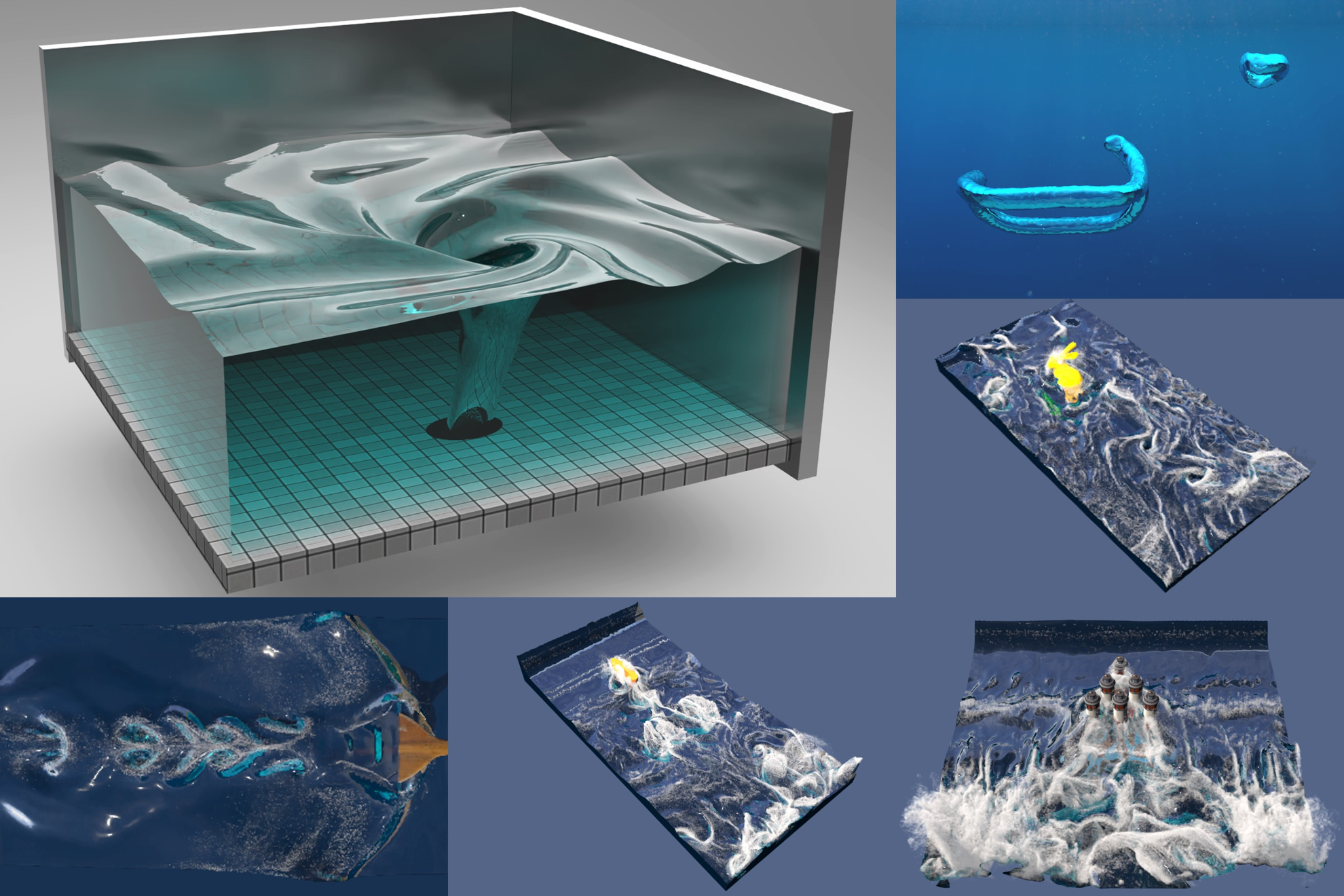
ACM TOG / SIGGRAPH · 2022
Free-surface Clebsch
Vortical liquid flows with evolving free surfaces, implemented using the SimpleX framework.
A Clebsch method for free-surface vortical flow simulation

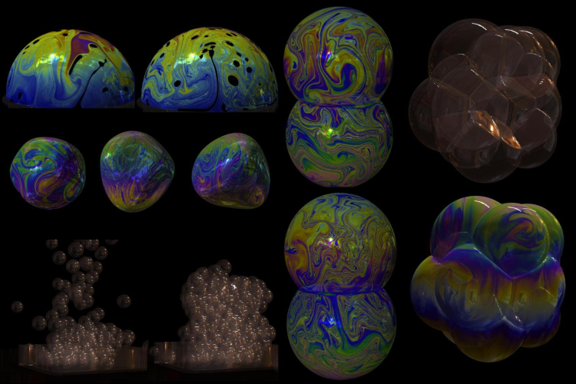
ACM TOG / SIGGRAPH · 2021
SPH Bubble
Particle-based thin-film dynamics, coupling surface deformation with flow within the film.
Thin-film smoothed particle hydrodynamics fluid
Architecture
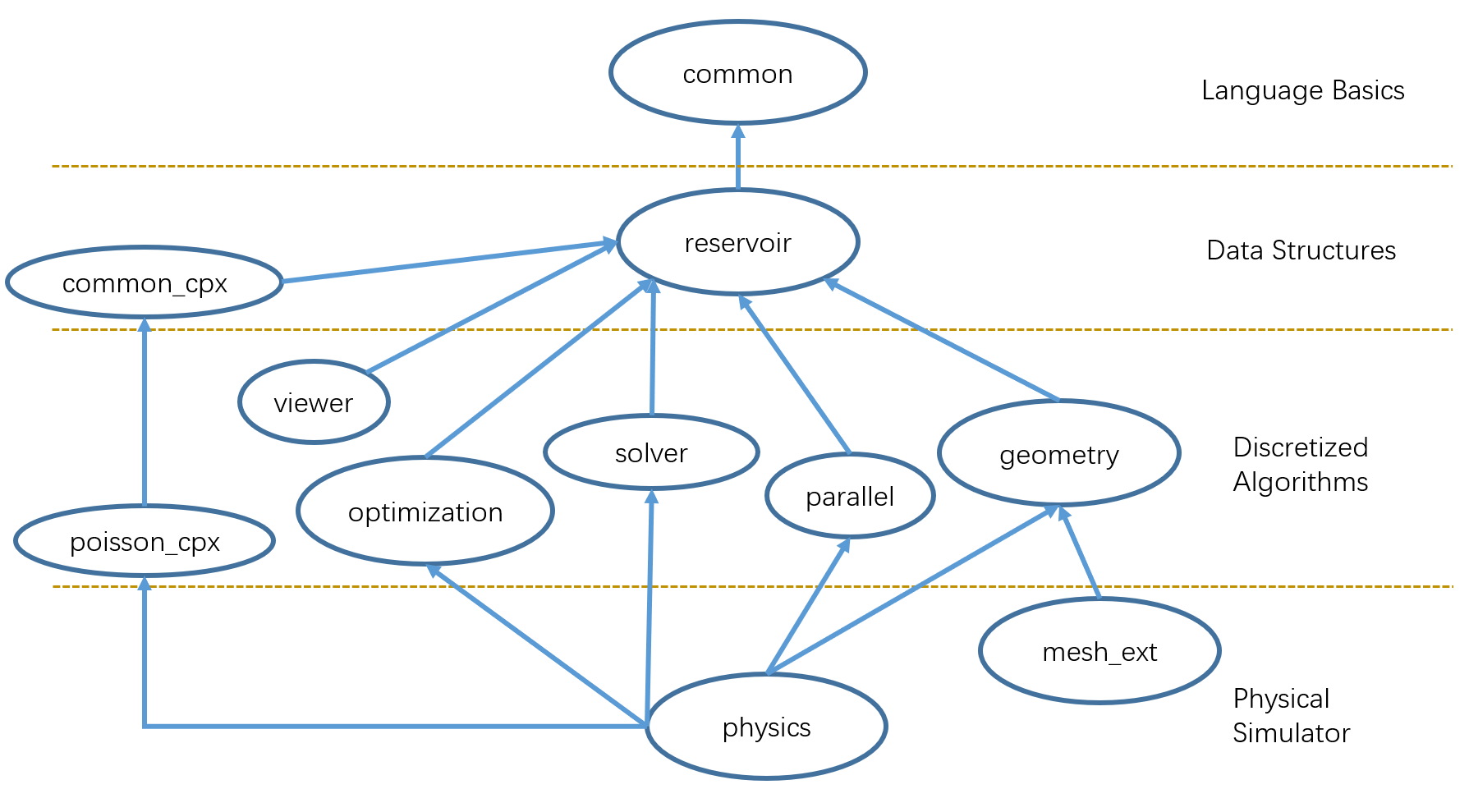
SimpleX organises reusable functionality into four layers: language basics, data structures, discretised algorithms and physical simulators. Common utilities and data containers underpin modules for geometry, solvers, optimisation, parallel computation and viewing. Physical simulators assemble these capabilities into specific models. The arrows in the original diagram show how modules depend on one another.
The library includes MAC grids, simplicial meshes, particle systems and level sets, allowing projects to choose representations suited to their physics. Shared linear solvers, including multigrid components, support the computational work beneath these models. The viewer provides a common way to inspect simulation output during development.
Application code remains separate from the reusable library and build infrastructure. This makes SimpleX useful as a research foundation: an individual project can introduce a new formulation while reusing established data structures, solvers and visualisation tools. Maintenance of those shared components therefore supports work beyond a single paper.
Supporting a wider research programme
SimpleX also supports computational design and topology optimisation. Examples include:
- Cellular Topology Optimization on Differentiable Voronoi Diagrams (IJNME, 2023), which explores continuously optimisable cellular structures.
- A Marker-and-Cell Method for Large-Scale Flow-Based Topology Optimization on GPU (SMO, 2022), whose public implementation includes SimpleX and uses its build and viewing tools.
Additional applications are documented in the software overview.
Getting started
Start with the SimpleX repository and README for its structure, examples and build documentation. For focused research implementations, see SPH thin-film fluid and MELP thin-film and foam simulation, each with its own usage instructions.